Faisal Mosque Islamabad: Timings, Dress Code & Complete Visitor Guide
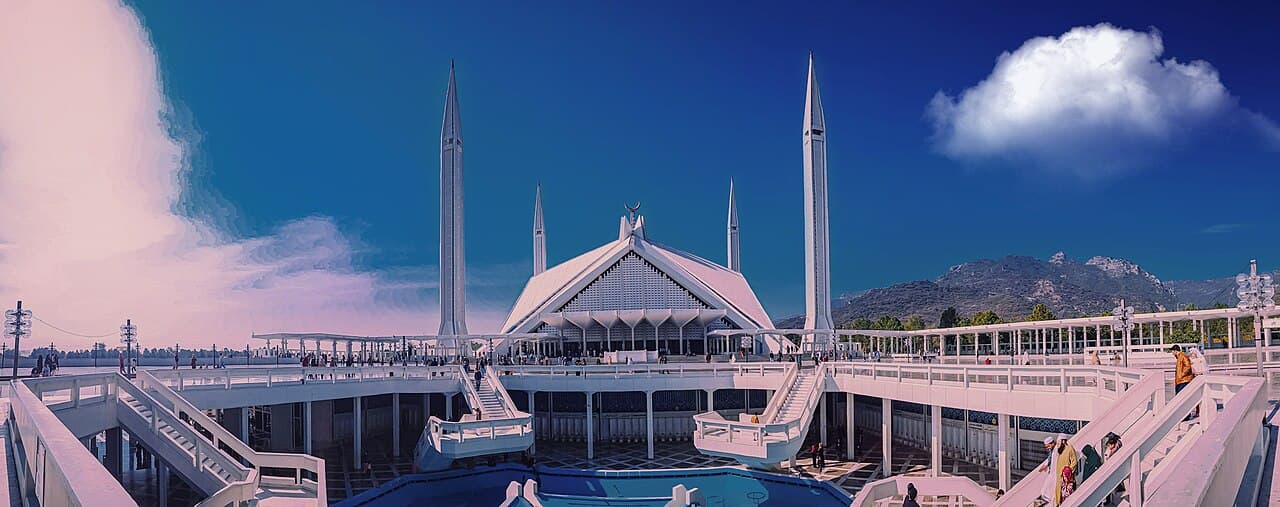
Everything you need to visit Faisal Mosque properly: the architectural story of Turkish designer Vedat Dalokay's winning 1969 design, exact non-Muslim visiting hours, the dress code enforced at the gate, photography rules, the best camera angles, and what most visitors walk past without noticing.
Faisal Mosque is one of the most architecturally original sacred buildings constructed anywhere in the world in the twentieth century. That claim is not hyperbole — it is the considered view of architectural historians who have examined the full brief. Turkish architect Vedat Dalokay's design rejected every visual convention of mosque architecture and created something that has no precedent and, decades later, no imitators. This guide is for visitors who want to experience it properly rather than photograph it from the car park and leave.
The Architecture: Understanding What You Are Looking At
The Competition and the Designer
In 1969, the Government of Pakistan launched an international design competition for a grand national mosque. Forty-three entries were submitted from around the world. Turkish architect Vedat Dalokay won. His proposal was radical: no dome (the defining visual feature of Islamic sacred architecture for over a thousand years), no horseshoe arches, no arabesque ornamentation. Instead, an eight-sided concrete shell modelled on the form of a Bedouin tent — a reference to Islam's origins in the Arabian desert — rising 40 metres at its peak and enclosing a prayer hall of extraordinary spatial power.
Construction Timeline and Funding
Construction ran from 1976 to 1986 — a decade-long project that required solving structural engineering problems no mosque had previously posed. The project was funded by the government of Saudi Arabia, a gift from King Faisal bin Abdulaziz — hence the name. King Faisal was assassinated in 1975, one year before construction began; the mosque became a memorial to him as well as a national landmark.
Scale and Capacity
- Prayer hall interior: accommodates 10,000 worshippers
- Courtyard capacity: approximately 24,000 additional worshippers
- Surrounding grounds: capacity expands to approximately 100,000 for major prayers (Eid, Friday Jumu'ah)
- Minarets: four, each 88 metres tall — visible from most rooftops in Islamabad's northern sectors
- Total site area: 5,000 square metres (prayer hall footprint only)
The Interior: Sadequain's Calligraphy
The prayer hall interior is intentionally austere: white marble floors, minimal decoration, and light designed to fall from concealed apertures in the concrete shell. The deliberate counterpoint to this austerity is the calligraphy panel on the qibla wall — verses from Surah Al-Hashr executed by Pakistan's most celebrated modern calligrapher, Sadequain. His style is expressionistic and angular, giving the normally static form of Arabic script an energy that many visitors describe as unsettling in the best sense — as if the letters are in motion. This work alone warrants ten minutes of quiet attention that most visitors skip.
Visiting Hours for Non-Muslim Visitors
Faisal Mosque welcomes non-Muslim visitors outside of the five daily prayer times. The general visiting window is 9 am to 5 pm daily, though this shifts seasonally with prayer schedules — the mosque closes during each of the five prayers (Fajr, Dhuhr, Asr, Maghrib, Isha), each lasting approximately 20–30 minutes.
Practical rule: Download a prayer time app (e.g., Muslim Pro) set to Islamabad and check the schedule before you go. Asr (afternoon prayer) typically falls around 3:30–4:30 pm depending on the season and is the prayer most likely to interrupt an afternoon visit. There is no entry fee.
Ramadan note: Visiting hours are modified during Ramadan. Tarawih prayers after Isha extend well into the night; the mosque is closed to non-Muslim visitors during these extended evening sessions. Visiting in the late morning during Ramadan is the most practical approach.
Dress Code (Enforced at the Gate)
The dress code is non-negotiable and is enforced by mosque staff at the entrance.
- Women: Full coverage required — arms, legs, and hair. A hijab or large scarf, loose trousers or a long skirt, and a long-sleeved top. Abayas and headscarves are available to borrow free of charge at the entrance gate — the supply is adequate but bring your own if you have a preference for comfort or fit.
- Men: Legs must be covered — trousers required. Shorts are not permitted inside the prayer hall or the courtyard. Short-sleeved shirts are acceptable.
- Both: Shoes must be removed before entering the main prayer hall. Shoe storage racks are provided at the entrance. Carrying shoes in a bag is permitted inside the courtyard.
Visitors who arrive inappropriately dressed will be turned away from the prayer hall or offered covering — politely, but firmly. Do not test this.
Photography Rules
Photography is permitted freely in the courtyard and on the exterior grounds. Inside the prayer hall, photography is a matter of respect and timing:
- During prayer times: No photography whatsoever inside or immediately outside the prayer hall. This is absolute.
- Outside prayer times: Quiet, non-flash photography is generally permitted inside the hall. Do not photograph worshippers engaged in individual prayer without consent. Do not use tripods or gimbal stabilisers inside the hall — they attract staff attention and are likely to be declined.
Best Camera Angles
- Front colonnade at sunrise: The east-facing main facade catches the first sun while the surrounding city is still in shadow. The colonnade pillars frame a series of symmetrical shots with the four minarets behind. Arrive before 7 am from October through February.
- Courtyard centre, shooting up: Standing at the courtyard midpoint and angling upward captures all four minarets in a single wide-angle frame. A focal length of 16–24mm is needed; a standard 50mm cannot hold all four minarets in frame.
- Margalla Hills Trail 5 viewpoint: The summit viewpoint of Trail 5 (approximately 1.5 hours hiking from the trailhead) provides the only elevated perspective on the mosque complex from the north — the four minarets visible in the middle ground with the city spread below them. This is the photograph that most visitors never know exists.
- Library Hill viewpoint (east side): A small rise accessible via a path from the eastern car park. Almost unknown to casual visitors, this vantage gives an elevated, slightly off-axis view of the whole complex at sunset.
What Most Visitors Walk Past Without Noticing
The Islamic Research Institute Library
Within the mosque complex sits one of the most significant collections of Islamic scholarship, jurisprudence, and manuscript studies in South Asia. The Islamic Research Institute, founded 1960, relocated to the mosque complex after construction. The library building is on the northern side of the grounds and is largely unstaffed for casual visitor access, but the exterior and the institutional context are worth noting — particularly for anyone with academic interest in Islamic studies. The institute publishes the journal Islamic Studies and its holdings are consulted by researchers across the Muslim world.
The Rose Garden
On the western side of the mosque complex, tucked behind a low hedge in a space most visitors never reach, is a formal rose garden maintained by the Capital Development Authority. It blooms from late February through April with dozens of varieties, and the contrast between the intimate scale of the garden and the monumental concrete structure behind it is genuinely striking. The garden has acquired an unofficial reputation as a location for proposals — something about the combination of beauty, scale, and privacy. It is rarely mentioned in any official visitor material.
Parking and Getting There
The mosque has a large dedicated car park accessible from the main Faisal Avenue approach, directly below the main colonnade. Parking is free. Friday and Eid prayers draw much larger crowds, so the car park can fill and service roads become informal overflow. For these occasions, use a currently operating ride-hailing service and ask to be dropped at the main gate. The Islamabad Metrobus has a stop at Faisal Avenue/Jinnah Avenue junction, approximately 800 metres from the mosque gate — a comfortable walk in cool weather.
Combining Faisal Mosque With Other Sites
- Daman-e-Koh viewpoint: 10 minutes' drive north from the mosque up the Margalla Hills access road. The viewpoint looks back down over the mosque and the entire Islamabad grid — the definitive cityscape photograph and a natural pairing with a mosque visit.
- Shakarparian National Park: 15 minutes' drive south. The Pakistan Monument (the iconic four-petal marble structure) sits within the park and provides a second major architectural landmark for a combined visit.
- F-7 Kohsar Market: 10 minutes' drive. The city's best cluster of cafes and restaurants — a natural lunch or dinner destination after the mosque visit.
Story
Culture
Reading time
6 min
Legacy editorial
First published 12 June 2025
Verify changing facts and prices independently.
More scenes from the destination
General destination planning
Check current details before you go
These official links are general planning resources, not evidence for this article. Opening hours, fares, prices, access rules and businesses can change, so confirm details independently for your dates.
Taqi Naqvi
AI product builder, writer, and Islamabad enthusiast. Building the Top 10 network to document the best of Pakistan's cities - honestly.
Connect on LinkedIn →