The Complete Faisal Mosque Guide: Everything Visitors Need to Know
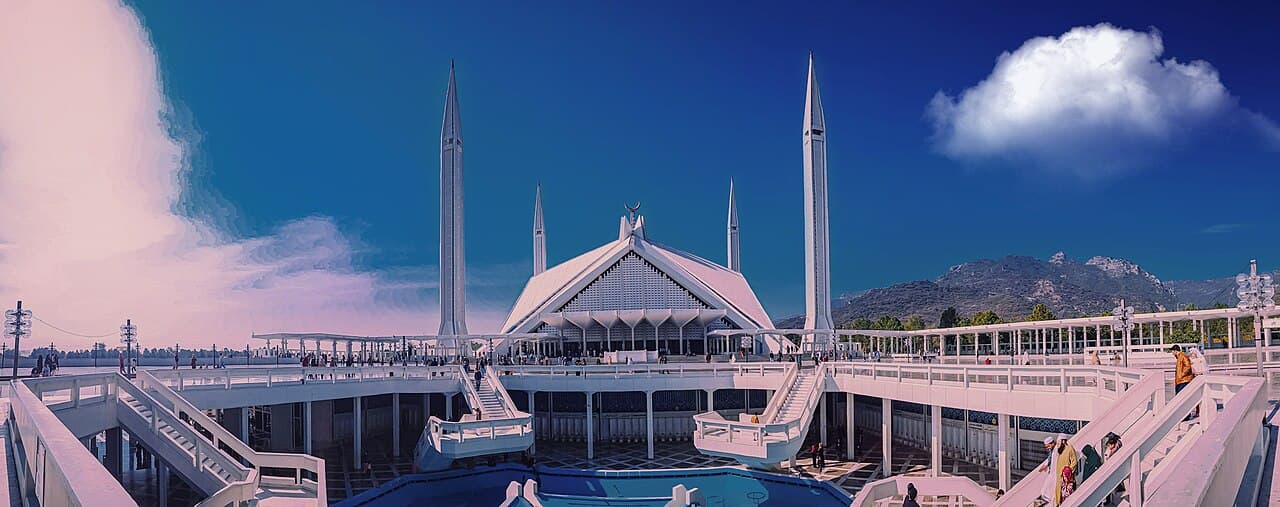
The Faisal Mosque is one of the most architecturally significant buildings in the Islamic world. This guide covers the architecture, visiting hours, dress code, photography rules, parking, the best light for photos, and what most visitors miss entirely.
There is a moment, approaching the Faisal Mosque from the main avenue that descends from the Margalla foothills, when the building resolves from a hazy white shape into something unmistakable. The four pencil-thin minarets — each 88 metres tall — frame a concrete shell that looks like nothing else ever built for Islamic worship. No dome. No arched colonnades. Instead: a Bedouin tent rendered in angular concrete, anchored to the Pakistani capital as if it had always been there and always would be. It takes a moment to understand that you are looking at a masterpiece.
This guide is for everyone who wants to visit Faisal Mosque properly — not just photograph it from the car park and leave.
The Architecture: What You Are Actually Looking At
The Faisal Mosque was designed by Turkish architect Vedat Dalokay, who won the 1969 international competition from a field of 43 entries. Construction ran from 1976 to 1986, funded by Saudi Arabia's King Faisal, after whom the mosque is named. Dalokay's design rejected every precedent in mosque architecture: no traditional dome, no horseshoe arches, no Arabesque ornamentation. Instead, he designed an eight-sided concrete shell rising to a 40-metre peak, enclosing a prayer hall that can accommodate 10,000 worshippers inside. The total mosque complex, including the courtyard, holds approximately 300,000 people.
The four minarets are not merely decorative. They function structurally as lightning conductors and visual anchors for the flat Islamabad grid — visible from almost any rooftop in the city's northern sectors. At night, lit from below, they turn the western approach to the Margalla Hills into something unexpectedly cinematic.
The Interior
The prayer hall interior is vast and deliberately austere: white marble floors, minimal ornamentation, and lighting designed to fall from above through concealed apertures in the concrete shell. The effect is meditative. The calligraphy on the qibla wall — verses from Surah Al-Hashr — was executed by the prominent Pakistani artist Sadequain, whose angular, expressionistic style gives the normally static form of Islamic calligraphy an almost architectural energy. Most visitors rush through the interior; Sadequain's work alone warrants ten minutes of quiet attention.
Visiting Hours
The mosque is open to non-Muslim visitors outside of the five daily prayer times. The most important practical rule: do not attempt to enter during Fajr, Dhuhr, Asr, Maghrib, or Isha prayers. The prayer schedule shifts daily with sunrise and sunset — check a prayer time app set to Islamabad before you go. Outside of prayer times, the mosque generally opens to visitors from approximately 9 a.m. to 6 p.m., though this can vary seasonally and during Ramadan or religious observances. There is no entry fee. Friday midday (Jumu'ah) prayer draws enormous crowds; visiting on Friday afternoon after prayers offers the unusual experience of the courtyard slowly emptying while the late-afternoon light falls across the marble.
Dress Code
The dress code is enforced and non-negotiable. Women must cover their hair, arms, and legs entirely — a large scarf and loose trousers or a long skirt are sufficient. Headscarves are available to borrow at the entrance gate if you arrive unprepared, but bringing your own is more comfortable. Men must cover their legs at minimum — shorts are not permitted inside the prayer hall or the courtyard. Both men and women must remove shoes before entering the main hall; shoe storage racks are provided at the entrance. The mosque management enforces these rules politely but firmly; visitors who are inappropriately dressed will be turned away or given covering.
Photography Rules and Best Angles
Photography is permitted in the courtyard and exterior. Inside the prayer hall, photography is a matter of judgment and respect — during prayer times it is entirely off-limits; outside prayer times, quiet, discreet photography without flash is generally tolerated. Do not photograph worshippers without their consent.
The Best Angles for Photographs
- The Avenue approach: The straight boulevard descending from the Margalla Hills directly toward the mosque's main facade gives the classic establishing shot — four minarets symmetrically framing the tent structure. This works best in the hour before sunset when the light comes from behind you and hits the white concrete directly.
- The courtyard interior, looking up: Standing at the centre of the vast marble courtyard and shooting upward gives a frame of the four minarets against blue sky or clouds. A wide-angle lens is essentially mandatory here — the minarets are too tall and too spread for a standard focal length to capture all four.
- The Margalla backdrop: Shooting from the western side of the mosque complex puts the forested Margalla Hills directly behind the structure. This is the angle that contextualises the mosque within its landscape. The best light for this shot is the early morning — arrive by 7 a.m. in winter — when the hills are still partially shaded and the mosque facade catches the first sun.
- Sunset from the Library Hill: The small hill to the east of the mosque, accessible via a path from the car park, gives an elevated view of the whole complex at sunset. This vantage point is almost unknown to casual visitors and is where the most atmospheric photography is possible.
The Surrounding Margalla Backdrop
The site selection for the Faisal Mosque was deliberate: the structure was positioned to sit at the head of Islamabad's central axis, framed by the rising Margalla Hills behind it. This integration of building and landscape is one of the design's great subtleties. From inside the mosque's courtyard, looking north, the hills fill the skyline above the low boundary wall. In spring, when the Margalla forest is a vivid green and the sky is clear after rain, the visual effect is among the most beautiful in any capital city in South Asia. In winter, after a snowfall on the upper Margalla ridge — which happens several times per season — the white hills and white concrete create a visual harmony that even the most architecturally indifferent visitor notices.
Parking and Access
The mosque has a large dedicated car park accessible from the main Faisal Avenue approach. Parking is free. On Friday afternoons and during major religious observances (Eid prayers particularly), the car park fills entirely and overflow parking extends onto the service roads — arrive early or use a ride-hailing service. The Islamabad Metrobus has a stop near the mosque; for visitors staying in F-sectors, it is a practical alternative to driving. The main entrance gate is on the southern facade; the side gates are for worshippers and are not the correct visitor entry point.
What Most Visitors Miss
Two things. First, the Islamic Research Institute and library building on the mosque grounds, which houses one of the most significant collections of Islamic scholarship in South Asia — largely unstaffed for casual visitors but worth noting for anyone with academic interest. Second, the small rose garden on the western side of the complex, which blooms in March and April and provides an unexpectedly intimate contrast to the monumental scale of the mosque behind it. The garden is where Islamabad residents come for quiet contemplation and the occasional proposal — it has an earned reputation for romance that the official visitor materials somehow never mention.
Story
Culture
Reading time
6 min
Legacy editorial
First published 26 April 2025
Verify changing facts and prices independently.
More scenes from the destination
General destination planning
Check current details before you go
These official links are general planning resources, not evidence for this article. Opening hours, fares, prices, access rules and businesses can change, so confirm details independently for your dates.
Taqi Naqvi
AI product builder, writer, and Islamabad enthusiast. Building the Top 10 network to document the best of Pakistan's cities - honestly.
Connect on LinkedIn →